
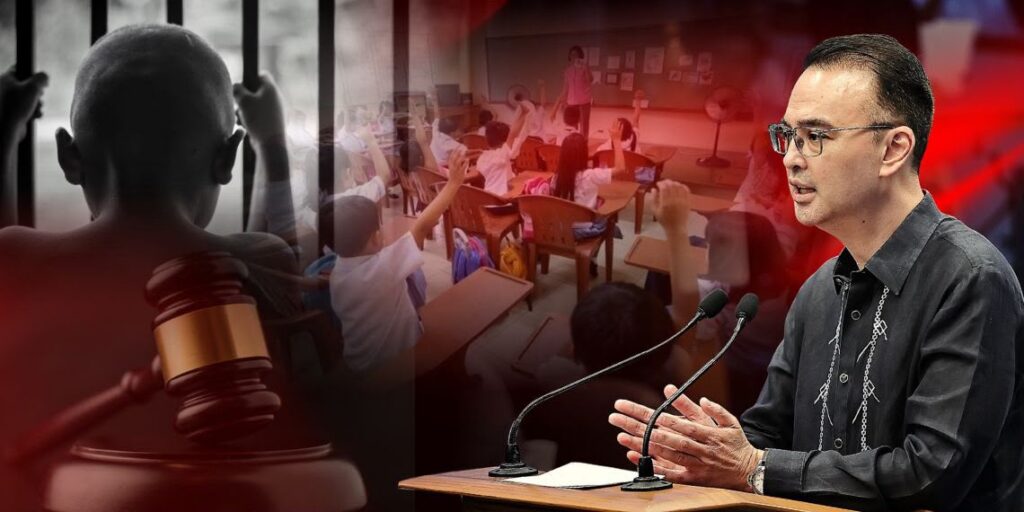
Senate Minority Leader Alan Peter Cayetano has called for a whole-of-society review of the environment shaping Filipino children amid recent incidents of school violence involving minors, saying talks on amending the juvenile justice law should focus on deterring youth crimes without treating children as hardened criminals.
In a Facebook livestream on June 24, 2026, Cayetano said he understands the public’s cry for justice, especially from the families of the victims.
“I just want to really pray for the parents, for the loved ones ng mga nasawi. And of course, ask people to be sensitive, to pray for them… We understand their cry for justice,” he said.
This month, the country was shocked by a deadly shooting involving two minor students at San Jose National High School in Tacloban City, which killed three students and injured several others, as well as separate stabbing incidents involving elementary and high school students inside campuses in Cavite.
“Hindi tayo pwedeng ma-desensitize d’yan. Hindi pwedeng maging normal iyan,” Cayetano said.
But amid renewed calls to amend the Juvenile Justice and Welfare Act, the Christian senator urged lawmakers to be careful in crafting reforms, saying the goal should be to deter violence without exposing children further to criminality.
“It’s really getting to a consensus of what law will be most proactive and relevant to us where we can protect our young people, not expose them to criminality, not treat them as hardened criminals, but also deter them and their parents from going into violence and violent crimes,” he said.
Under the law, children 15 years old and below are exempt from criminal liability, but are subjected to intervention programs such as diversion, rehabilitation, counseling, and placement in facilities such as Bahay Pag-asa instead of ordinary detention.
Children above 15 but below 18, on the other hand, may be held liable if they acted with discernment. Otherwise, they are also placed under intervention.
Cayetano said the discussion on teenagers who think they can “do anything” without consequence has been going on for more than a decade, but the answer must go beyond simply lowering the age of criminal liability.
For him, the country must examine the “total environment” of students, including what they consume online, and what they learn and experience in school, at home, and in their communities.
“Everything is just a shock to us. So, we have to reflect kung anong tinatanim natin sa isip ng mga bata,” he said.
Cayetano emphasized that schools, homes, and churches should remain the safest places for children.
“The reason that we’re more sensitive when it is schools, churches, or home is because this is the place where children should be safe,” he said.
A critical first step, he said, is to address the reduction in school hours caused by classroom congestion, which has left many children spending less time learning and more time exposed to the streets and social media.
“Ano naman kinalaman ng K to 12 sa nangyari? Eh guys, half day na lang po most of our schools. I don’t know exactly sa Leyte, but most of our schools sa highly urbanized places are half day. So mas madami pang oras ang bata sa lansangan at saka sa social media,” Cayetano said.
He said the ongoing investigations by relevant agencies should not stop at the criminal act itself but should also look into the conditions that allowed such violence to grow.
“I hope as the investigations go on, y’ung local, sa DepEd, y’ung NBI, PNP, I think Congress and Senate, tingnan po natin y’ung total environment ng estudyante,” he said.
Cayetano emphasized that the country must act with both justice and wisdom because children remain the nation’s most important resource.
“Ang number one resource natin is not oil or gas or gold or livestock. It’s our children,” he said.
“We have to have very, very deep thought into this problem because existential ‘to sa pamilya ng bawat Pilipino,” he added.