
Senator-Judge Alan Peter Cayetano on Wednesday probed the difference between how banks assess large withdrawals made by private customers and government agencies, noting that government withdrawals may involve large amounts but are not necessarily illegal.
Cayetano raised the point during the 10th day of Vice President Sara Duterte’s impeachment trial on July 29, 2026, as former LandBank Shaw Boulevard Branch Manager Violeta Constantino testified about four P125-million checks cashed by Duterte’s staff on separate occasions.
The senator-judge asked Constantino if she was familiar with confidential or discretionary funds in government parlance. Constantino answered that she was not.
Cayetano then clarified that in private accounts, banks are more familiar with a customer’s usual transaction patterns under the “know your customer” policy.
Because of this, he said, banks often ask questions when a private customer suddenly withdraws or deposits an amount much larger than usual.
“Suddenly, magwi-withdraw ng P3 million. Minsan, nagtatanong, ‘di ba?…Ganoon din sa deposit,” he said.
Cayetano contrasted this with government transactions, saying banks may notice when the amount is large but would release the funds if they are dealing with identified government representatives and the documents are in order.
“‘Pag government, as long as you’re dealing with the people you identified with, whether that’s DPWH, DOTr, basta’t everything is in order. Magtataka lang kapag sobrang laki ng amount, but then you’ll release it,” Cayetano said.
He then asked Constantino whether the unusual size of a withdrawal alone makes an encashment of a government agency illegal.
He cited an instance when his office during his tenure as Foreign Affairs Secretary had to obtain at least P50 million from LandBank to assist overseas Filipino workers stranded in airports and seaports after a major storm.
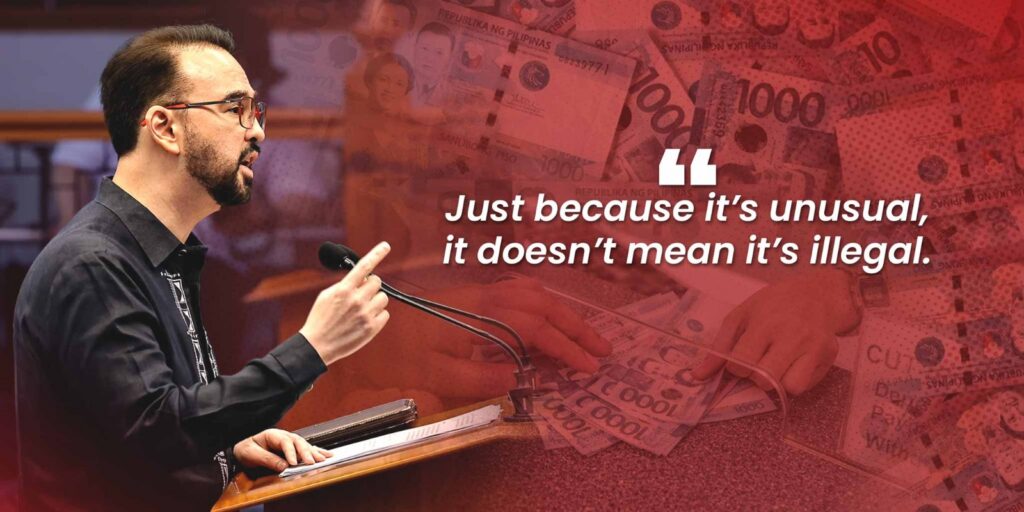
“Just because it’s unusual, it doesn’t mean it’s illegal. Tama po ba?” Cayetano asked.
In response, Constantino said as far as the encashments made by Vice President Duterte’s office are concerned, “wala naman pong illegal.”
Cayetano also noted that the concepts of “usual” and “unusual” are different from “suspicious” and “covered” transactions.
He said a transaction may be considered usual if the branch regularly handles transactions involving roughly the same amount. Suspicious and covered ones, on the other hand, carry legal implications.
Under the Anti-Money Laundering Act, a covered transaction is a cash or monetary transaction exceeding P500,000 within one banking day. A suspicious transaction involves any amount that lacks economic sense, deviates from a client’s profile, or links to unlawful activities.
Cayetano emphasized the importance of making this distinction clear in the impeachment proceeding.
“As we go along, let’s help the public understand what’s the difference between ‘covered,’ ‘suspicious,’ and ‘usual’ or ‘unusual,’ para lang walang conclusions that are made that are prejudicial to either the prosecution or the defense,” he said.