
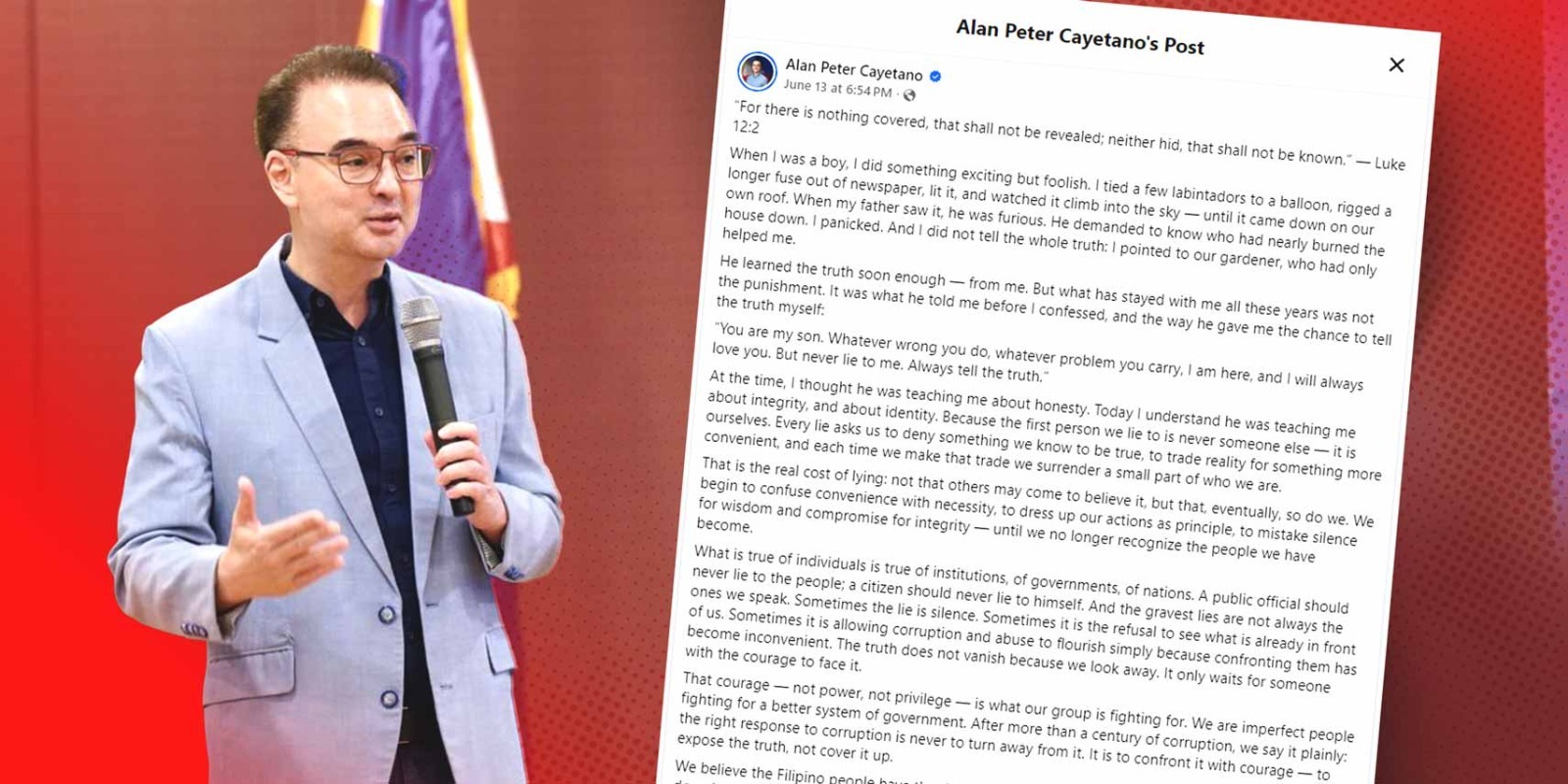
“For there is nothing covered, that shall not be revealed; neither hid, that shall not be known.” — Luke 12:2
When I was a boy, I did something exciting but foolish. I tied a few labintadors to a balloon, rigged a longer fuse out of newspaper, lit it, and watched it climb into the sky — until it came down on our own roof. When my father saw it, he was furious. He demanded to know who had nearly burned the house down. I panicked. And I did not tell the whole truth: I pointed to our gardener, who had only helped me.
He learned the truth soon enough — from me. But what has stayed with me all these years was not the punishment. It was what he told me before I confessed, and the way he gave me the chance to tell the truth myself:
“You are my son. Whatever wrong you do, whatever problem you carry, I am here, and I will always love you. But never lie to me. Always tell the truth.”
At the time, I thought he was teaching me about honesty. Today I understand he was teaching me about integrity, and about identity. Because the first person we lie to is never someone else — it is ourselves. Every lie asks us to deny something we know to be true, to trade reality for something more convenient, and each time we make that trade we surrender a small part of who we are.
That is the real cost of lying: not that others may come to believe it, but that, eventually, so do we. We begin to confuse convenience with necessity, to dress up our actions as principle, to mistake silence for wisdom and compromise for integrity — until we no longer recognize the people we have become.
What is true of individuals is true of institutions, of governments, of nations. A public official should never lie to the people; a citizen should never lie to himself. And the gravest lies are not always the ones we speak. Sometimes the lie is silence. Sometimes it is the refusal to see what is already in front of us. Sometimes it is allowing corruption and abuse to flourish simply because confronting them has become inconvenient. The truth does not vanish because we look away. It only waits for someone with the courage to face it.
That courage — not power, not privilege — is what our group is fighting for. We are imperfect people fighting for a better system of government. After more than a century of corruption, we say it plainly: the right response to corruption is never to turn away from it. It is to confront it with courage — to expose the truth, not cover it up.
We believe the Filipino people have the right to know what was done with their money, and what was done in their name.
That is the conviction shared by Senate President Pro Tempore Loren Legarda and Senators Pia Cayetano, Joel Villanueva, Rodante Marcoleta, Imee Marcos, Robin Padilla, Jinggoy Estrada, Ronald “Bato” dela Rosa, Bong Go, and Mark and Camille Villar. Together we have refused to let the flood control investigation be buried. We have followed the evidence wherever it leads, as we promised our people. And we insist that every witness be heard rather than silenced — even when standing our ground means angering some of the political, business, and religious elites of this country. They own much and control much. But they do not own the truth.
We are not of one body or one mind. We are twelve duly elected officials — and in truth we are more, but some are being frightened into silence. That is another story. We come from different parties, different regions, and different convictions, and we do not agree on everything. But we agree on what matters: the truth must not be buried, and there must be accountability for all. A fair and impartial impeachment process. A fair and impartial flood control investigation. An independent Senate, free to represent the Filipino people. A majority that will help lift Filipinos out of poverty and chaos. The investigations must not be stopped, the people’s money must be accounted for — and no camp, no name, no institution, and no powerful interest may be allowed to decide which truths the Filipino people are permitted to know.
This is not a new struggle. It is the same one every generation inherits — between truth and convenience, courage and silence, principle and expediency. It is the struggle Rizal answered, and Bonifacio, and Mabini, and Ninoy Aquino. What they defended was never a faction, a surname, or a bloodline. It was truth, courage, and sacrifice.
So let me be clear about Ninoy. No family holds a monopoly on his name, because no one holds a monopoly on heroism. Heroism is not inherited; it is earned. People Power itself proved as much — it was not the triumph of a single family, but of ordinary Filipinos who decided that truth mattered more than fear.
I am proud of what they did and what they sacrificed. I do not compare myself, or our group, to them — but I do identify with what they fought for. The revolution is unfinished. Who will fight for the truth?
Some now ask who has the right to invoke Ninoy’s name. With respect, that is the wrong question. We do not claim to be him, and we do not compare ourselves to his heroism. The question worth asking is whether any of us — myself included — is willing to live by the standard he set: the standard of Dr. Jose Rizal and Gat Andres Bonifacio; the standard set by the honest janitor and the taxi driver; the standard of sacrifice our OFWs set when they leave to raise other people’s children so that their own may simply survive.
On the things that matter, right and wrong are not in doubt: stealing from the people is wrong, corruption is wrong, betraying public trust is wrong. The real test is not whether these things are evil. It is who is willing to confront them — to ask the hard questions, to challenge powerful interests, and to tell the truth when silence would be safer.
By that measure, Ninoy’s legacy does not belong to those who merely claim it — not even to those who bear his likeness and his name. It belongs to those willing to carry on the fight, not just repeat the slogans.
History does not remember the men who inherited great names. It remembers those who proved worthy of them. Today that name is Aquino. Tomorrow it could just as well be a Reyes, a Cruz, a Santos — anyone, and everyone, willing to stand for the truth.
Our heroes were not perfect men. Rizal was not. Bonifacio was not. Ninoy was not. They had their fears and their failings, as we all do. What made them worthy of remembrance is that when history asked something of them, they answered — choosing truth over comfort, principle over convenience, country over self.
That is the challenge before us now: not to claim the legacy of our heroes, but to deserve it. Because the greatest tribute we can offer them is not to speak in their name. It is to continue their work.
A final word. Just as our heroes were imperfect, so were the heroes of Scripture. Yet GOD gave them their mission — and the strength to carry it out. Nation-building is tedious, difficult, and dangerous. These are not ordinary times. These are not ordinary problems. They demand extraordinary solutions — and extraordinary sacrifice from ordinary people. But the purpose is clear, and the mission remains. The only question left is who will answer: “Here am I. Send me.”