
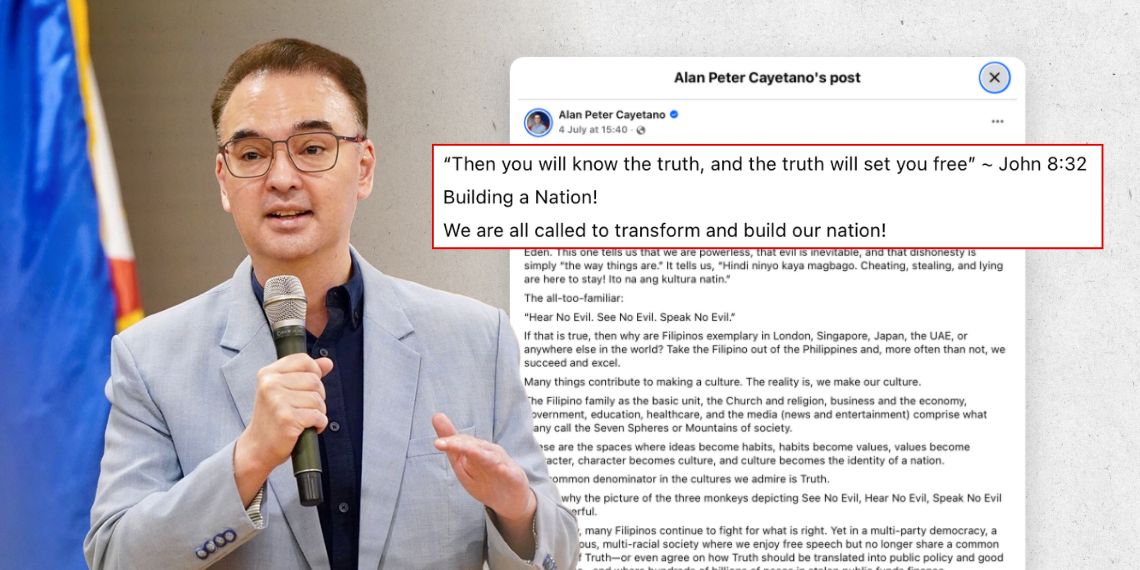
“Then you will know the truth, and the truth will set you free” ~ John 8:32
Building a Nation!
We are all called to transform and build our nation!
If we want to transform and build, we cannot pretend evil does not exist. We must confront it, expose it, and ultimately defeat it.
Behind every weak nation is a lie. It is a similar serpent that whispered the lie in the Garden of Eden. This one tells us that we are powerless, that evil is inevitable, and that dishonesty is simply “the way things are.” It tells us, “Hindi ninyo kaya magbago. Cheating, stealing, and lying are here to stay! Ito na ang kultura natin.”
The all-too-familiar:
“Hear No Evil. See No Evil. Speak No Evil.”
If that is true, then why are Filipinos exemplary in London, Singapore, Japan, the UAE, or anywhere else in the world? Take the Filipino out of the Philippines and, more often than not, we succeed and excel.
Many things contribute to making a culture. The reality is, we make our culture.
The Filipino family as the basic unit, the Church and religion, business and the economy, government, education, healthcare, and the media (news and entertainment) comprise what many call the Seven Spheres or Mountains of society.
These are the spaces where ideas become habits, habits become values, values become character, character becomes culture, and culture becomes the identity of a nation.
The common denominator in the cultures we admire is Truth.
That is why the picture of the three monkeys depicting See No Evil, Hear No Evil, Speak No Evil is so powerful.
Even today, many Filipinos continue to fight for what is right. Yet in a multi-party democracy, a multi-religious, multi-racial society where we enjoy free speech but no longer share a common standard of Truth—or even agree on how Truth should be translated into public policy and good governance—and where hundreds of billions of pesos in stolen public funds finance disinformation, shield the guilty, and conceal those truly responsible, it is hardly surprising that confusion has become part of our national conversation.
In fact, confusion is both a spiritual and political strategy. Sabi nga, “If you can’t convince them, confuse them.” If one cannot stand for Truth, point to the apparently most guilty.
We know what is right and wrong, but if we are deliberately being misled, then what can we really do about it?
Politics may divide, but Truth should unite us.
“Sana All” should mean: Sana all maimbestigahan, ma-solve, at magbago. Not: Sana all na kalaban lang.
Individually, and to a certain degree, many communities are standing for Truth. But as a nation that easily sacrifices justice and institutions for what seems “right at the moment,” I dare say there is mass confusion.
Everyone—including the corrupt—claims to be fighting for what is right, yet offers no direction toward real reform and transformation.
That is the irony.
No one campaigns on promoting corruption. No one publicly defends stealing, cheating, or lying. Everyone speaks of justice. Everyone speaks of reform. Everyone claims to be serving the people.
Leading us to believe that we are all—or at least most of us—doing something to change the status quo, conquer corruption, and put real reforms in place.
When everyone claims to be on the side of Truth, but “Truth” itself becomes selective, confusion follows. Justice becomes political. Accountability becomes tribal. Wrongdoing is condemned only when committed by our opponents and excused when committed by our allies.
That is no longer a search for Truth. It is a search for victory.
And when victory becomes more important than Truth, everyone loses.
Generation gaps, geographical differences, and socioeconomic classes all deepen the confusion. Too often, the circumstances of our birth determine the opportunities we receive. Where we are born, the family we are born into, and the education we can afford divide society into the haves and the have-nots, making opportunity a privilege for some rather than a right for all.
When people grow up living different realities, they naturally see the world differently, making it harder to agree on what is true, what is just, and what kind of nation we should become.
If this were mathematics, it would lead us to the same principle found in the BIBLE.
Find the least common denominator—the one thing everyone can agree on.
The Truth.
Thus, our journey must be a truth-seeking one.
It cannot be selective nor vindictive.
It must be honest and whole, leading to repentance, repentance to reform, and reform to revival.
Only then can we truly say that we have chosen to see evil for what it is, hear the truth no matter how uncomfortable, and speak the truth no matter the cost.
Knowing the Truth leads to both justice and repentance, which sets us on the right path to building a nation!
What truths do we need to seek? What’s on your checklist?
Can we all pray about these at 7:00 a.m. or 7:00 p.m., seven times a week?
Prayers can move mountains, and prayers can build a nation!