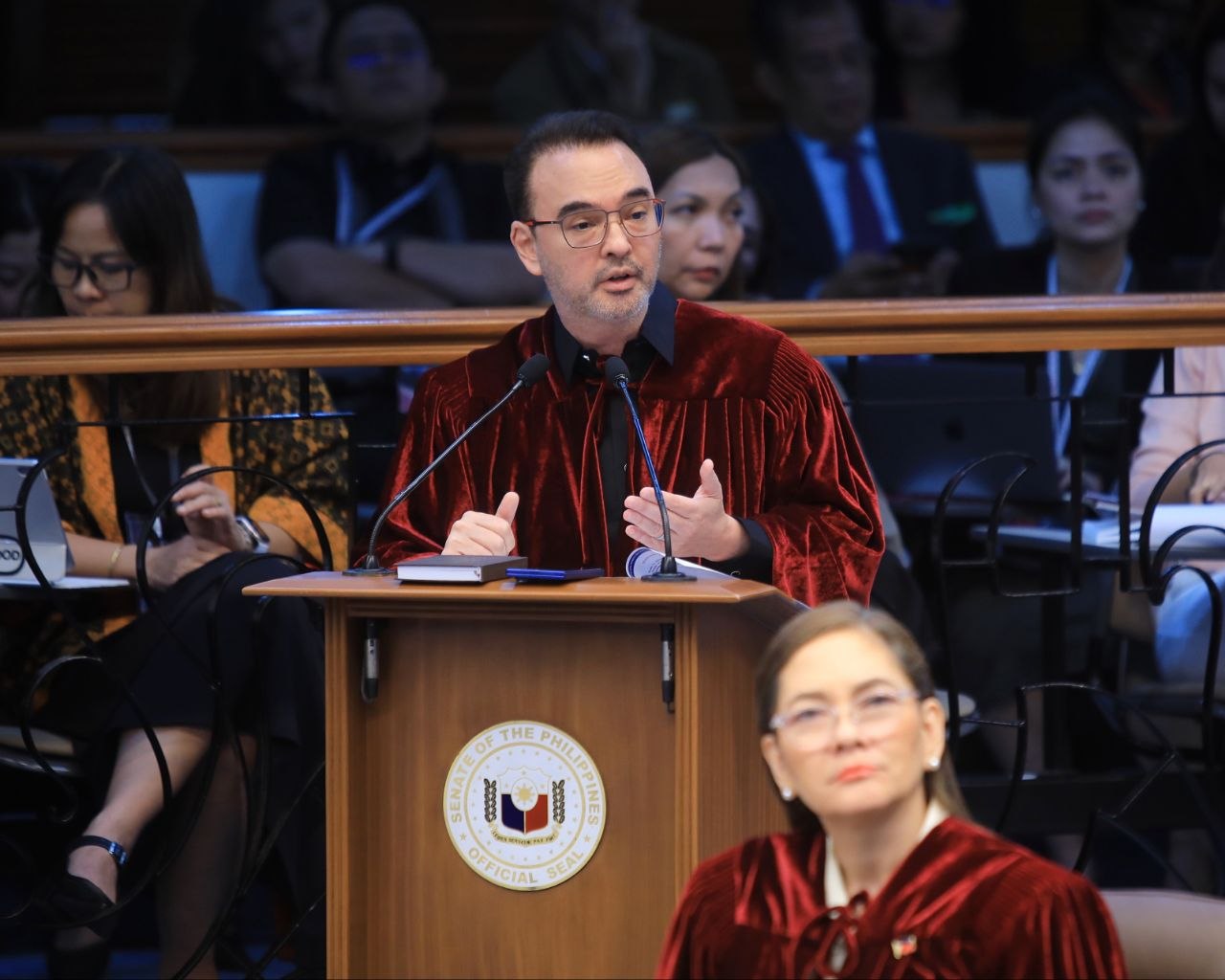
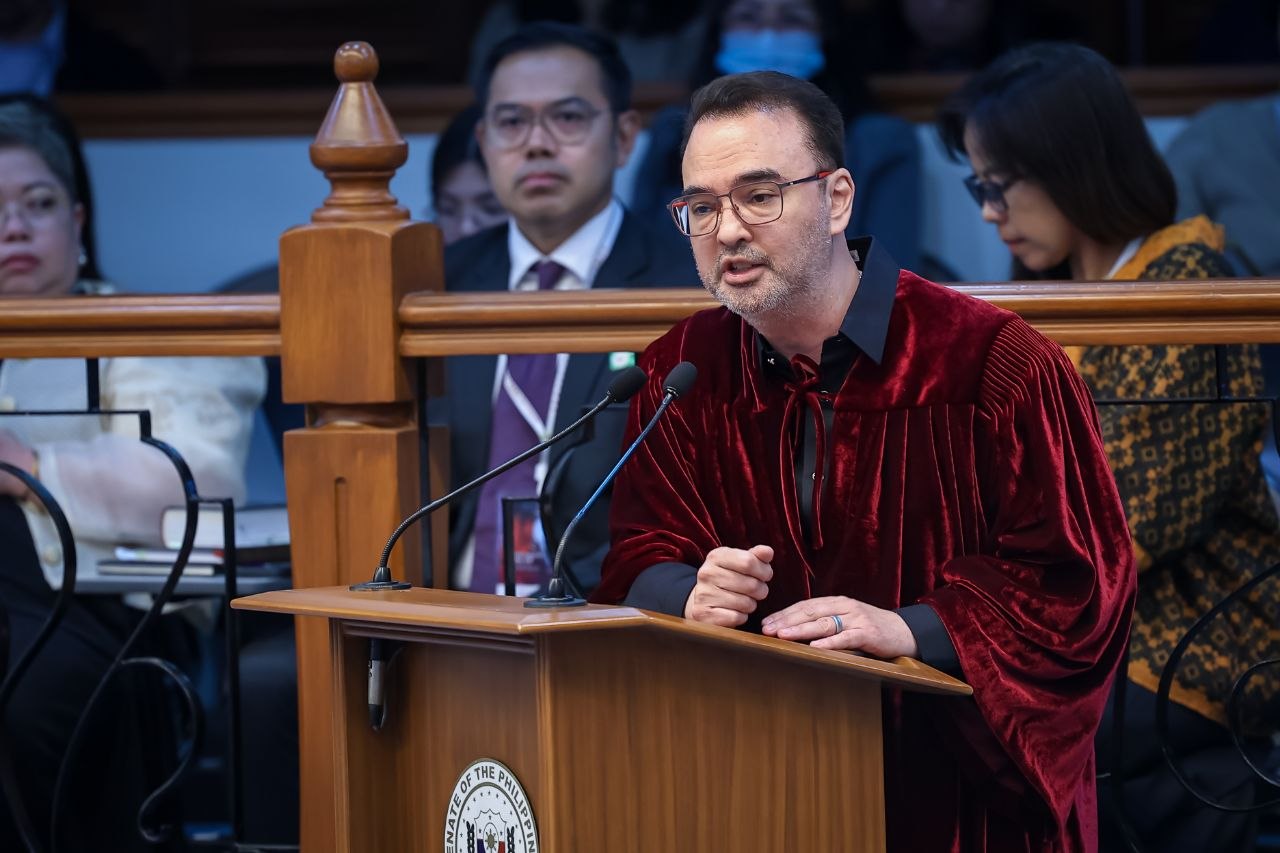
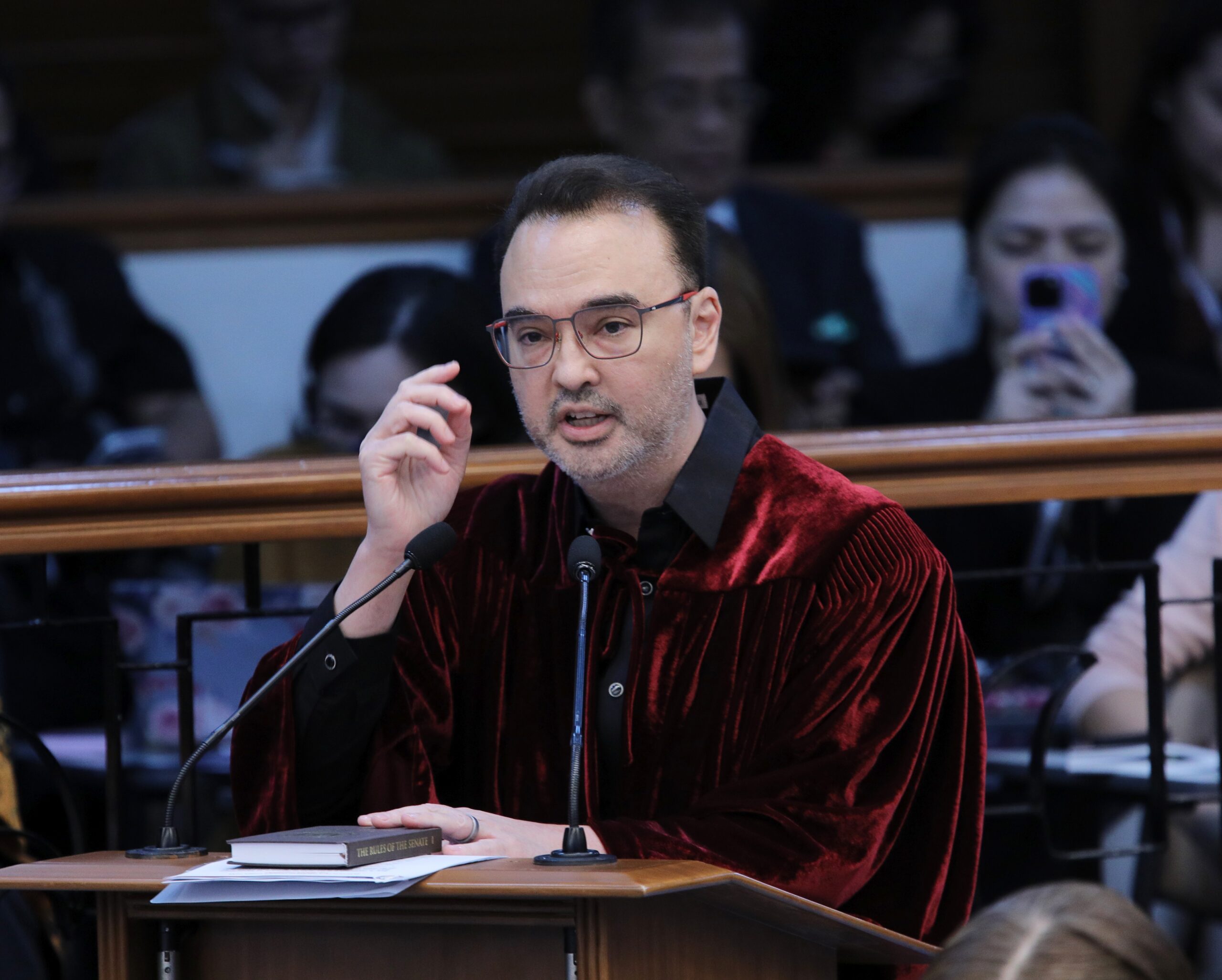
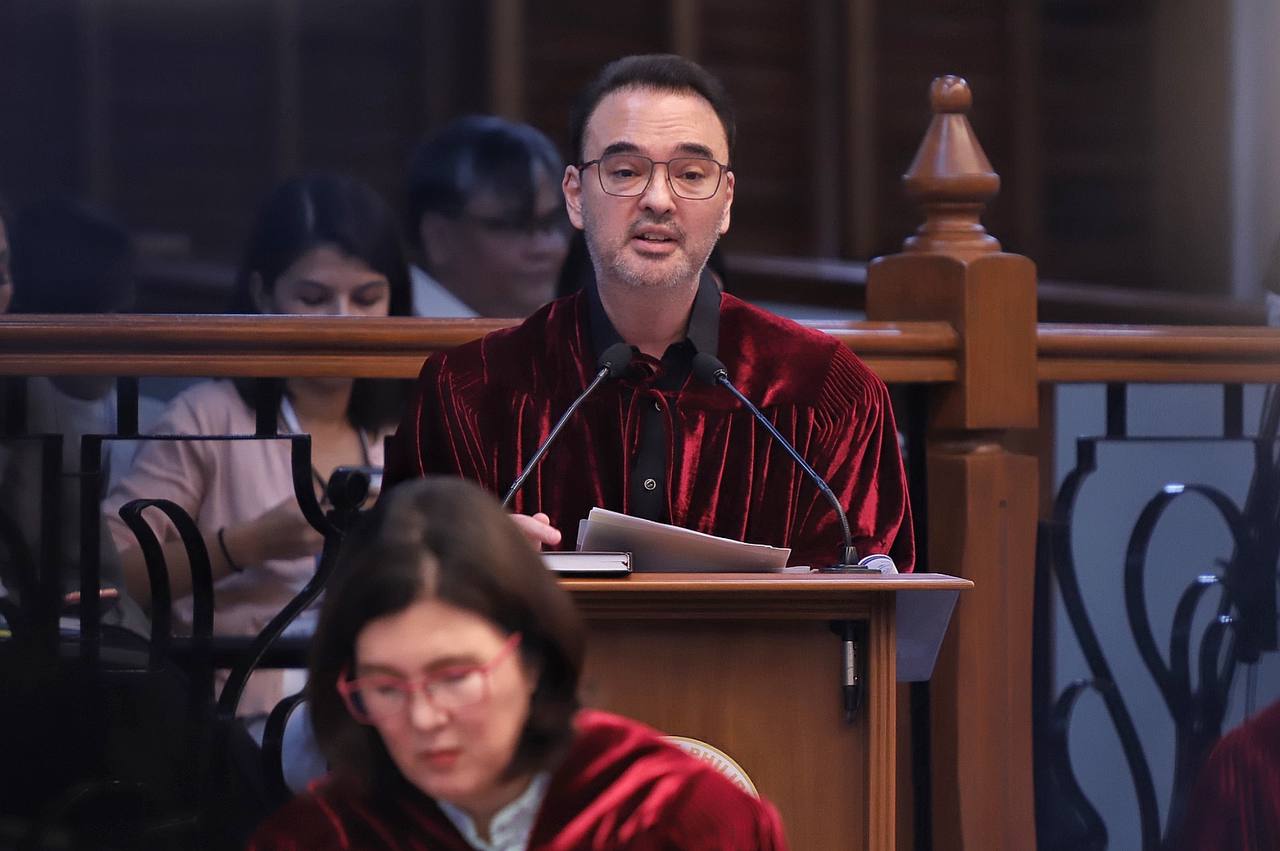
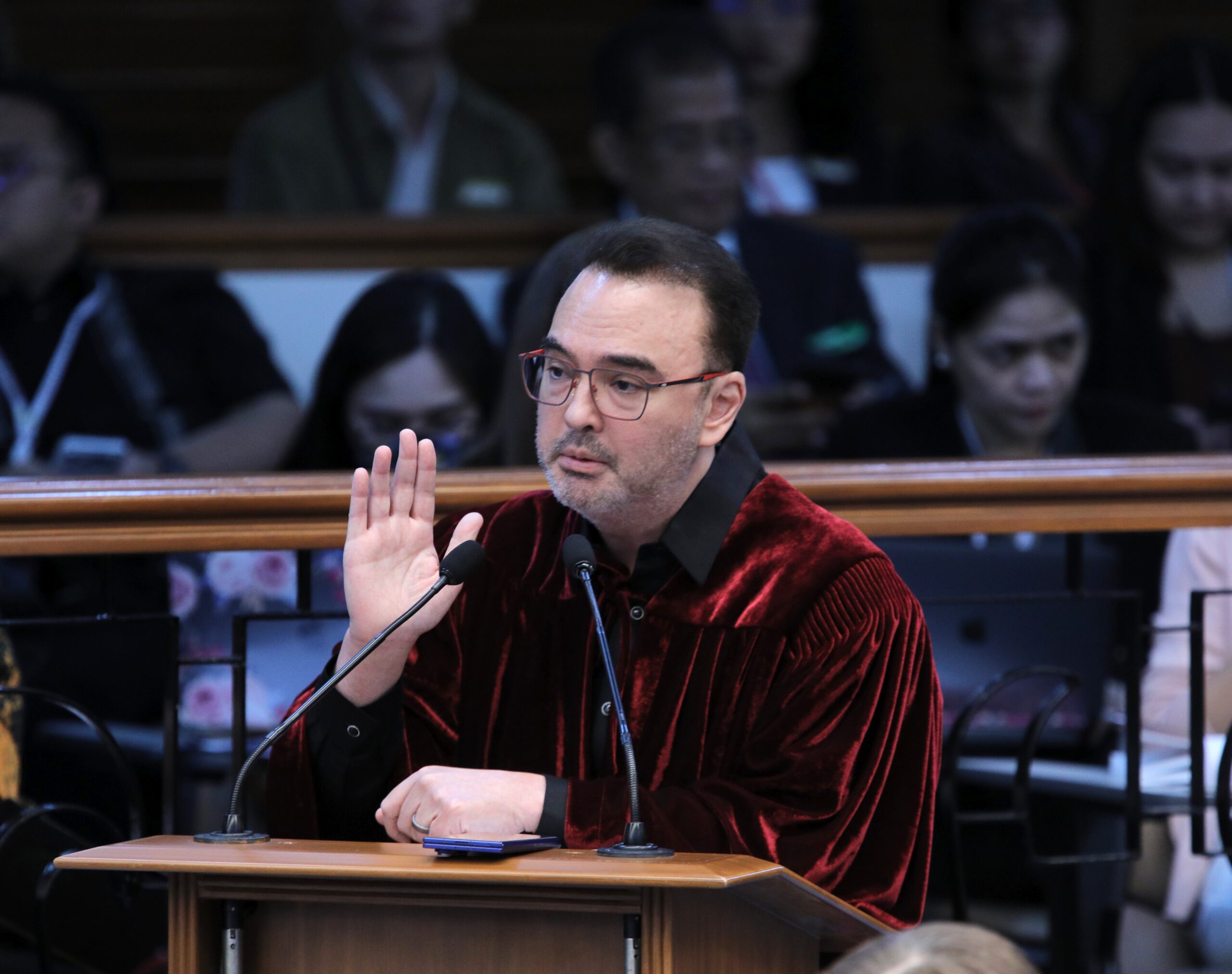
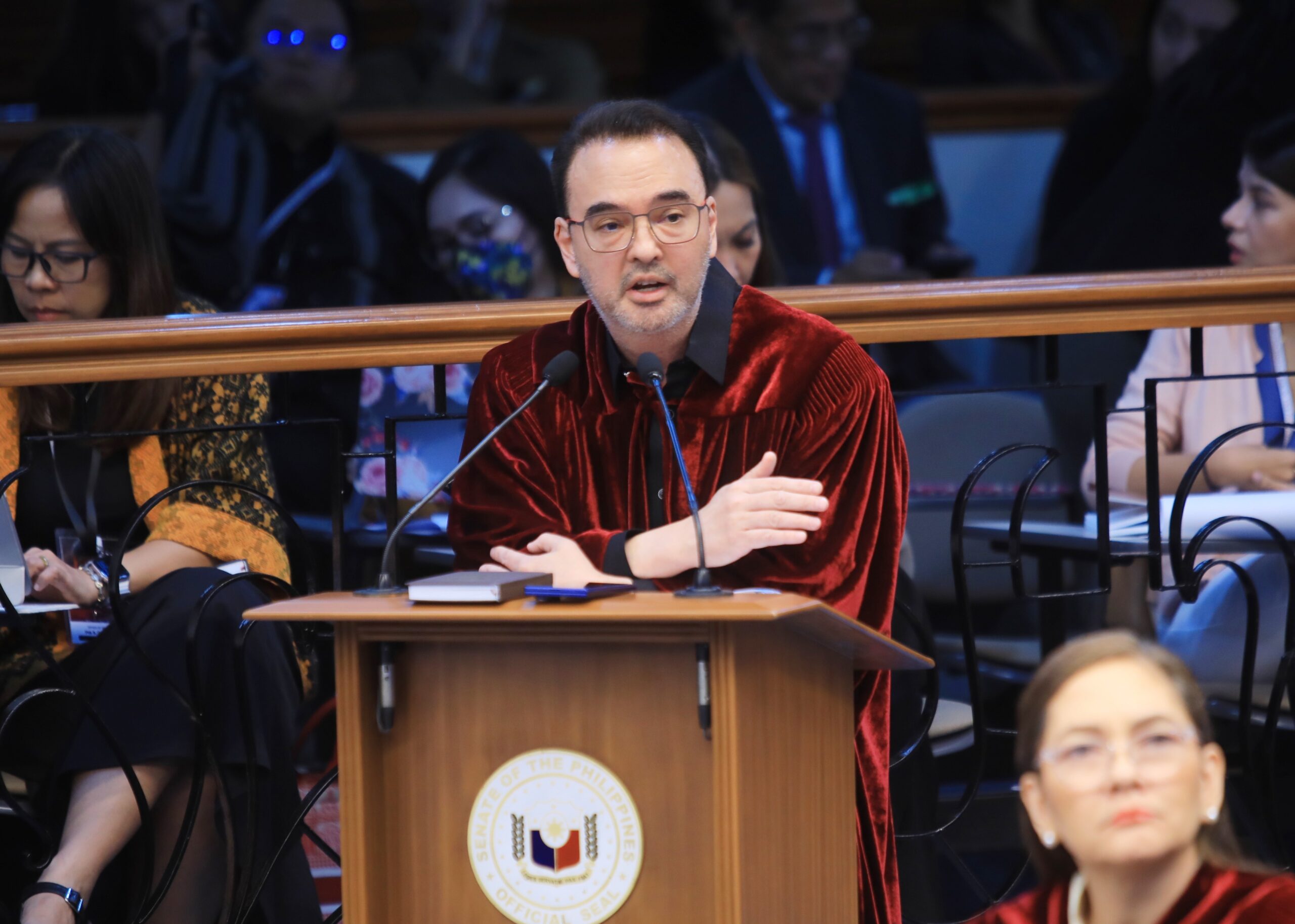
SENATOR-JUDGE ALAN CAYETANO:
(0:00:00) Mr. Senate President and Presiding Officer, As the preamble of the Constitution said, imploring the aid of the Almighty God, and as you said yourself, that every stage of this impeachment, we have to make sure na patas, we have to make sure na may due process, we have to make sure that it is fair. It is very clear in the Constitution of the Philippines that the Presiding Officer is the Senate President. Section 3, Paragraph 6 of Article 11 of the 1987 Constitution, the Senate shall have the sole power to try and decide all cases of impeachment.
(0:00:47) When sitting for that purpose, the Senator shall be on oath or affirmation. When the President of the Philippines is on trial, the Chief Justice of the Supreme Court shall preside, but shall not vote. No person shall be convicted without the concurrence of two-thirds of all members of the Senate.
(0:01:05) I will go to that other two-thirds inquiry later on because this is another threshold issue, Mr. President. But to further the point of order, with the indulgence of Senator Lacson so that we can discuss this intelligently. On the final question of whether impeachment, sorry, on the issue of who shall preside, under the Constitution, it may seem that it does not say who should preside.
(0:01:44) But if you look at the records of the Constitutional Commission, No. 40, 26 July 1986, the framers deliberately chose the phrase, sorry, Mr. President, I am referring to Section 6, Article 11, and then Constitutional Commission No. 41, 27 July 1986.
(0:02:18) The presiding officer, Mr. Treñas, Commissioner Davide, is recognized. Thank you, Mr. Presiding Officer. I have some proposed amendments on Section 3, subparagraph 5. The presiding officer, Mr. Trenas, the gentleman may proceed.
(0:02:30) Mr. Davide, who later became Chief Justice, this is without prejudice to whatever amendments may be accepted by the committee when the Aquino amendments will be taken up. It would consist in adding a new sentence on line 20 before the phrase, no person shall be convicted, inserted the following, all other cases the President of the Senate shall preside. The presiding officer, what does the committee say, Mr. Monsod? It is not understood, is it not understood that when the President of the Philippines is on trial, it is only time when the Chief Justice of the Supreme Court will preside.
(0:03:04) It is necessary to say that the Senate President shall decide during all the time. Presiding Officer, Mr. Davide, Mr. Presiding Officer, I precisely presented this because we had a distinction when it comes to the Chief Justice of the Supreme Court, but with that clarification that in all other cases it should be the President of the Senate who shall preside, I withdraw my amendment. So it is but elementary, Mr. President, in statutory, especially construction of the Constitution, that the spirit as well as the letter is followed.
(0:03:37) The spirit of the Constitution is that it is the Senate President who will preside. This is not an ordinary statement dictum or it was not a capricious statement in the discussion. Precisely because the Senate President is elected by the majority.
(0:03:58) As an example, when Senator Pimentel did not like the vote and did not vote with the majority, he offered to resign. So the point, Mr. President, is this. Number one, institutional integrity.
(0:04:12) We need to protect the legitimacy of these proceedings. Even if the substitute Presiding Officer acts fairly, a conviction or acquittal reached under a constitutionally defective process would invite judicial challenge and cast doubt on the validity of the entire trial. Do we want to go 30 weeks? If we follow the number of days submitted in the pre-trial, 62 and 30, and 3 days every week, so 30 weeks yun.
(0:04:43) Then after the 30 weeks, we’ll end up in the Supreme Court kasi kine-kwestyon natin kung tama ba kung sino nag preside? Why is it important? Why can’t any of the 24 preside? Remember, under our very rules, hindi ko na babasahin para mas umikli, in our very rules, the Presiding Officer can decide on the spot or he can throw it to the body or he can call a caucus or whatever you call it to be able to decide. And we experienced that during the Corona trial.
(0:05:16) And that’s one reason why everyone acclaimed the late Senate President Enrile, not only because of how he carried it himself, but how the consensus and how he carried it with the minority. Secondly, jurisdiction and regularity.
(0:05:33) The Senate’s jurisdiction over an impeachment trial is constitutional. The exercise of jurisdiction must conform to the Constitution. And the Senate’s validity adopted impeachment rules. We cannot say we’re following the Constitution, then we will not follow the Constitution. If the Constitution and its framers prescribe who shall preside, who are we to change the Constitution here today? We cannot enlarge or diminish the Constitution arrangement through internal rules or through ad hoc resolution. Lastly, due process.
(0:06:03) Kailangan malinaw po sa lahat ng partido, both to the prosecution and the defense, kung ano yung korte, kung ano ang two-thirds, kung ano ang charges, kung sino magpre-preside. So if now during the first day we’re going to change who’s going to preside, and it’s against the Constitution, what more changes are we going to do in the next few days? Ano ang limit na pwede natin palitan sa Constitution at hindi? The authority must come from the Constitution or the governing law, not from the vote of a tribunal. A litigant is entitled to have the case heard by the decision maker designation by law.
(0:06:42) The law cannot say that ang maghi-hear kay Sen. Marcoleta ay Sandiganbayan tapos sa Court of Appeals natin siya dadalhin. Hindi pwedeng sabihin sa RTC dapat i-hearing si Juan Dela Cruz tapos sa Sandiganbayan natin dadalhin.
(0:06:58) Hindi pwedeng sabihin tatlo sila sa CA pero in this case, nag-botohan kami, isa lang kami ang maghi-hearing. Proceedings before a judge or hearing officer who lacks the legal authority are invalid regardless of fairness of the proceedings. A judgment rendered by court without jurisdiction is null and void and may be attacked anytime.
(0:07:22) It creates no right and produces no effect. It remains basic fact that in law the choice of the proper forum is crucial. As the decision of a court or tribunal without jurisdiction is a total nullity, a void judgment for want of jurisdiction is no judgment at all. All performed pursuant to it and claims emanating from it have no legal effect. Tan vs. Cinco, GR No. 213054, June 15, 2016.
(0:07:51) Penned by Justice Perlas-Bernabe, 1st Division. The constitutional authority, Mr. President, is very clear. Now, let’s put that aside for a moment. But we’re not allowed to do that. But for a moment, let’s put that aside. The Constitution is not clear and does not tell us what to do.
(0:08:11) The rules of the Senate says that any amendment should be presented a day before. And that’s why the then minority, when I was Senate President, walked out because your contention was when we gave it to the Committee on Rules, kahit may isang araw na at binabalik ng rules, we did not follow the rules. So on the ramp session or alleged ramp session on June 3, first of all, you did not have a quorum of 13.
(0:08:41) But let’s assume, assume, for the sake of argument, I’m not giving you that point. As far as I’m concerned, it’s in the Supreme Court, walang quorum on 12. Assuming my quorum on 12, you did not follow the rules. There was not a one-day notice for the rules. And then if you look at the records, this impeachment court adopted the rules on May 18. So that means that it is this impeachment court that now has to adopt any amendment to the rules.
(0:09:20) We did not debate that amendment to the rule. We cannot now just change the rules. We’re here for the opening statements. We’re here for the trial. Are we here to change the rules? We’re changing the rules here today, Mr. President. So, Mr. President, later on I’ll ask permission to talk about yung two-thirds because both the issue of the presiding officer and the issue of what constitutes two-thirds of all members is a threshold issue.
(0:09:58) Para maintindihan lang po ng lahat, lalo po sa mga kababayan natin na nanonood, Merriam-Webster, simple definition, a threshold issue is a preliminary question, minimum requirement, or foundation condition that must be met or resolved before proceeding to the substantive merits of a case, project, or process. In this initial criteria, if this initial criteria is not satisfied, further action is typically dismissed or halted. I want to avoid that this impeachment trial will be declared null and void.
(0:10:44) I want to avoid walkouts. I want to avoid any delays, Mr. President. The Senate President is more than capable. He said he is willing. He said he is ready. He has been in many situations in his life that people say you cannot do it, but he has done well.
(0:11:04) He has studied. So what is the issue? Why do we have to vote for a presiding officer, Mr. President? Why can’t we follow the Constitution? So the point of order, Mr. President, is that amending the rules, implementing a null and void rule, and violating the Constitution will endanger this whole hearing, Mr. President. So please rule on the point of order, and I hope that the Senate President, who is more than able, will preside.
– Below is not for website
PRESIDING OFFICER GATCHALIAN:
(0:11:38) Thank you to the gentleman from Taguig. Before I express my views on the matter, let me just put into the record the facts on when we amended Rule 2 of the Rules of Procedure on the impeachment trials. On June 3, 2026, Senator Juan Miguel Zubiri proposed Senate Resolution No. 430, and that was adopted during that time. And then, on the same day, the same resolution was adopted and renumbered to Resolution No. 40. It was published on June 9, 2026 in the Philippine Daily Inquirer as well as Malaya.
(0:12:26) During that time, in June 3, when we amended the rules, everyone had the opportunity to express their views regarding the proposed resolution, and since no one objected, we adopted Resolution No. 430 and renumbered it to Resolution No. 40.
(0:12:47) That is anchored on our Constitution, Article 6, Section 3, Paragraph 8 of the Constitution, that the Congress shall promulgate its rules on impeachment to effectively carry out the purpose of this section. So, my view, to the good gentleman, let me just finish, sir. My view is this resolution has been duly approved, and everyone was given an opportunity to discuss that, to object. However, no one objected to that resolution, and it was duly approved by the body.
(0:13:33) So, any discussion regarding this resolution should be discussed in plenary when the Senate convenes as a legislative body. In the past presidents, during the Erap impeachment, November 15, 2020, the body, as well, approved the rules of impeachment in plenary.
(0:14:07) During the Corona impeachment, March 23, 2011, once again, Resolution No. 39 was adopted in plenary. So, any issues pertaining to this resolution should be discussed in plenary when the Senate convenes as a legislative body. So, that is the position of the Chair, and the view of the Chair on this matter.
SENATOR-JUDGE ALAN CAYETANO:
(0:14:35) Mr. President, first, may I dispute that you used the word fact. It is not a fact that the rules were changed because it is being disputed that first, there was no quorum at that day. Second, we are going to amend the rules of impeachment for the impeachment trial in plenary under the rules of the Senate. Section 136, second paragraph, says the rules may be amended by means of a motion that should be presented at least one day before its consideration. It was not presented on June 2. So, we did not follow our rules. So, a rule that was passed that did not follow our rules or an amendment that was passed that did not follow our rules is void. You cannot get anything out of it. It is a nullity. So, if today we pass a change in our rules and we do not follow our own rules in changing the rules, we cannot follow the rules.
(0:15:36) Secondly, Mr. President, the impeachment court already adopted our rules. Iba po ang plenary, tama po kayo doon, I agree with you there, iba po yung impeachment court. So, is the impeachment court now hostage or subject to whatever changes the legislative body does and we will not adopt? Then why did we adopt the rules when we took our oath? We adopted it because the impeachment court is not powerless to talk about our rules.
(0:16:08) But finally, Mr. President, for the sake of argument, just for the sake of argument, huwag na natin tingnan yung amendments, it’s against the Constitution. Can the impeachment court disobey the Constitution? If the Constitution says the presiding officer should be the Senate President, can we now say na “No, pagbotohan natin kung sino?” Because if we say that we can, what next will we add to the articles of impeachment? Will we lower the bar of the quantum of evidence needed? Will we say that balewala na lang yung pre-trial brief, at bahala na si Batman? So, Mr. President, I thought that’s why we have the rules. Because when we have the rules, it dictates fair play, and the rule says it is the Senate president who will preside.
(0:17:02) So, if now we’re not going to follow the rules, anong pinaguusapan nating patas? Anong pinaguusapan nating due process? Anong pinaguusapan nating fairness? It is who we chose as Senate president is a political. So, we made our case there that we would have more fair.
(0:17:22) You made your case, you got the majority. Now you got the majority, we will give you all the support, Mr. President. But we have to follow the Constitution. We cannot have a trial where we do not follow the Constitution, Mr. President… inaudible…
(Live feed was cut)
PRESIDING OFFICER GATCHALIAN:
(0:20:20) Magbigay ng pahayag, magbigay po ng legal opinion. But at that time, wala naman pong nag objected at inadopt naman po ng Senate in a legislative body. So, the position of the Chair, if there are any comments, any legal opinions, any issues, it should be done through the legislative body of the Senate.
SENATOR-JUDGE ALAN CAYETANO:
(0:20:49) Mr. President, there is no conflict, with your permission, Mr. President. There’s no conflict. If you want to discuss it, in three weeks, may session tayo. So, all we have to do today is follow the Constitution, you preside. Then, pagdating ng plenary, then we can debate whether we are allowed to amend the Constitution or not. Because, Mr. President, that’s why I premise this not as a parliamentary inquiry or as a point of information or whatever we may call it.
That’s why it’s a point of order. A higher point of order than the point of order in the rules is a point of order in the Constitution. The Constitution says it is the Senate President who will preside. So, are we saying now, Mr. President, that the rules can amend the Constitution? Is that the ruling of the Chair?
PRESIDING OFFICER GATCHALIAN:
(0:21:38) Before I make my final ruling on this matter, may I recognize the gentleman from Pampanga Senator Kiko Pangilinan.
SENATOR-JUDGE PANGILINAN:
(0:21:51) Thank you, Senate President. Mr. President, with all due respect, the Constitution does not provide that the Senate President must preside in cases of impeachment trial. What the Constitution provides is that when the President is undergoing impeachment, going through the trial, is being tried, the Chief Justice must preside. Nowhere in the Constitution in the provisions on public accountability and impeachment does it say that the Senate President must preside when the Vice President is under trial or any other impeachable officer. And precisely because of this, and precisely because the Constitution likewise allows Congress, not the impeachment court, Congress, to promulgate its own rules, which is what the Senate did in June 3. We promulgated, we proposed amendments to the rules under our rulemaking power, which, by the way, was subsequently ratified when we convened in a special session on June 17.
(0:23:17) The June 3 journal was ratified unanimously on June 17 when we had our special session. And in the June 3 minutes and the journal, precisely we approved the amendments to the rules. This was further ratified on June 17. Therefore, it is considered regular. The presumption of regularity now comes into fore. But having said that, Mr. President, the good gentleman from Taguig has brought this matter before the Supreme Court.
(0:23:58) And we agree with the point earlier raised by the Senate President. This matter should be either discussed in the Senate, in plenary, as a legislative body. Or, if he has questions which may in fact turn out to be valid, he has brought this matter before the Supreme Court.
(0:24:21) And therefore, this impeachment court is not the venue for this debate, Mr. President. If there is anyone who is out of order with due respect, I think the proper process is the matter is pending before the Supreme Court. There is no temporary restraining order. There was a request for a status quo ante order. It was not granted. And therefore, the presumption of regularity behooves us as an impeachment court to proceed.
(0:24:50) And finally, Mr. President, allow me to reiterate, the point of order is improper. In fact, the debate on this matter here in the impeachment court is out of order, Mr. President.
SENATOR-JUDGE GATCHALIAN:
(0:25:08) May I allow the gentleman from Taguig to rebut for two minutes and then we will make the final ruling.
SENATOR-JUDGE ALAN CAYETANO:
(0:25:29) Before I rebut, I’m from Ateneo Law School and what they taught us there is that you look at the records of the Constitutional Commission and then ‘pag klaro, klaro. But then let’s call someone from UP Law to see whether they were taught the same thing, Senator Pia. May I ask that Senator Pia be recognized before I rebut.
SENATOR-JUDGE PIA CAYETANO:
(0:25:56) Thank you, Mr. President. It’s not an Ateneo [and] UP issue, but always happy to stand before our colleagues and share our experience in the UP College of Law. I was prepared to address this to all our members of the bar in the Senate, but since it is Senator Kiko, my schoolmate, my teammate actually in the UP volleyball varsity team who stood up, I’ll also specifically address it to Senator Kiko.
(0:26:28) So dear Senator Kiko and our colleagues in the majority, knowing that you have members in the majority that are lawyers, and for those who are not lawyers, you definitely have consultants who are lawyers. Wala naman sigurong ni isang senator dito na walang consultant na abogado. Kahit ako na abogado…
(0:26:49) Marami rin akong staff na abogado rin. Why? Because these are legal issues. We need to talk to the experts. Kung paguusapan natin about mental health, physical health ng vice president of course we will not listen to lawyers, we will listen to doctors, right? So this is a legal issue. Let’s hear what the lawyers have to say.
(0:27:13) But let me just quote because I know the Senate President doesn’t have time to call on all the lawyers. So if you ask your lawyers in your staff, I’m sure nag abala sila, to look at the constitutional records, to look at the journal. I’m sure. And if they did not, please take out your cell phone now and text your staff. What does the constitutional journal, the records of the debate show? Sinabi na po ni Senator Alan Cayetano, you can question him. You can doubt him.
(0:27:47) Ask your staff. May I ask you, dear colleagues, let’s do our job well. The same way when you stand up and you tell me to do my job well and you disagree, I disagree with your point of view, I will listen intently to your point of view.
(0:28:00) And I’m looking at each one of you because I know because this is our solemn duty. What does the Constitution say? Nakalagay doon the Chief Justice, pag the President. Silent nga po sa iba. So sabi ng iba at yan ang sinasabi ng Senate President natin na mukhang pwedeng iba. So we looked at what the Constitutional Framers said. What did they say? Nagdebate na po sila, colleagues, nagde-debate tayo dito.
(0:28:30) Pag sinabi ng sponsor ito na yung paliwanag, yung nag-i-interpellate at nagbibigay ng amendment, sinasabi niya, ah okay, yung pala paliwanag mo, okay na ko. No need to amend. Yun at yun din ang sinabi. Let’s place ourselves in that position. Because that happens to us every day. Every day.
(0:28:51) Somebody stands up and says, ano ibig sabihin nito? And the sponsor will explain. Pag hindi maliwanag, sasabihin yung nag-i-interpellate or nag-a-amend, ay papa-amend ko kasi hindi maliwanag or I want to improve it. Pero kung nagka-intindihan naman, okay na.
(0:29:09) Eh yun nga yung binasa, tanungin niyo naman po yung staff nyo or let’s pause, let’s all get a copy. Let’s show it. because this is the foundation of this trial, na tama yung nakaupong presiding officer. So that’s my first point. Mag-abala naman tayo. Read it yourself, ask your staff to print a copy. In fact, on that note, may I ask Senator Alan’s staff to print a copy and give it to all our colleagues. Mabilis lang yan. Hindi na yan mapapatagalan. Show it. We can take judicial notice naman po siguro of it. Siguro naman alam na natin ang ibig sabihin ng judicial notice…